Aerial view of an industrial plant
STEP 3 · CREN · Powered by Novacab TESS

PCM
Heat Storage.

Recovered heat is worth nothing if you can't hold onto it. CREN's storage stage banks low-grade waste heat as latent heat in a Novacab TESS thermal battery — charged when heat is abundant, discharged exactly when you need it.

01 · RPC 02 · SRU Condenser 03 · PCM Storage 04 · ORC Power 05 · Greenhouse
0
thermal batteries installed in Canada — Gen 5 units now in the U.S.
0
ASHRAE Technology Award, at IBM Bromont
SPCM
Synthetic Phase Change Material — the thermal shock-absorber inside every unit
The core idea

TESS stores energy as heat —
not as electricity.

The Novacab TESS is a rechargeable thermal battery. It captures heat from an available source — exhaust, hot water, steam, thermal oil, solar heat, or engine heat — and stores that energy in a precisely programmed Synthetic Phase Change Material (SPCM). As the SPCM reaches its programmed phase-change temperature, it melts and banks a large amount of latent heat in a solid form, within a narrow temperature band, until it's needed. Then it's vaporized and used to spin a turbine and generate electricity.

01

Capture

Available heat is drawn from an available source such as exhaust, hot water, steam, thermal oil, solar heat, or engine heat.

02

Transfer

A heat-transfer fluid carries those BTUs through internal heat-exchange tubing embedded in the storage medium.

03

Store

Novacab's engineered SPCM melts as it absorbs the heat, storing it as latent energy within a narrow, precisely programmed temperature band.

04

Release

The stored heat comes back out as a stable thermal "hotplate" — a steady temperature, not a spike or a fade.

05

Generate

The hotplate vaporizes a closed-loop ORC liquid. The resulting vapor drives microturbines connected to electrical generators.

Inside the unit

Two loops, one exchange.
Hardware, not hype.

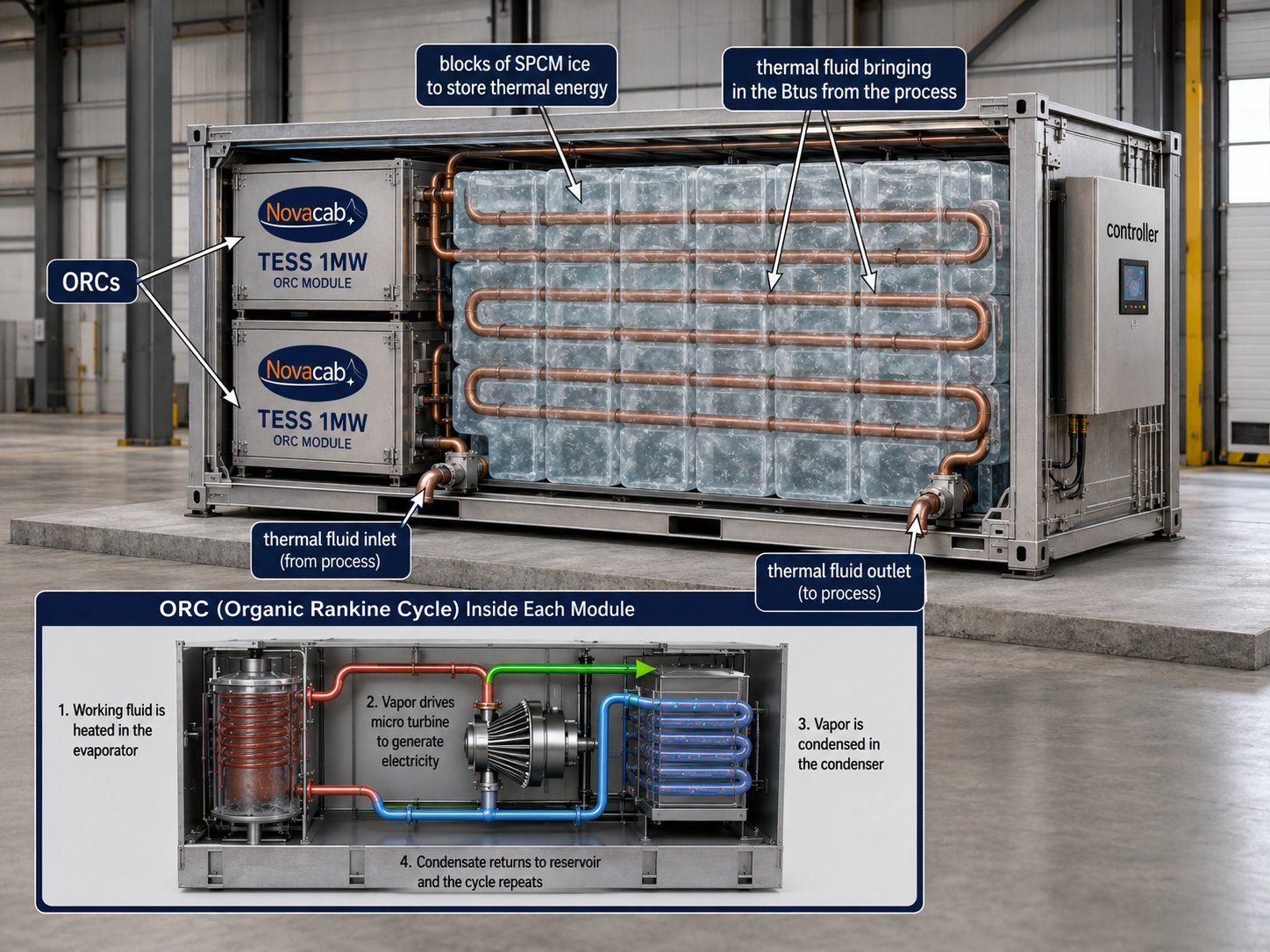
Inside the TESS unit, blocks of SPCM absorb recovered heat carried in by a thermal fluid loop. When the plant needs power, that stored heat is transferred to a pair of ORC modules, where it vaporizes a working fluid to drive a microturbine — the vapor is condensed afterward and the fluid recirculates rather than being consumed.

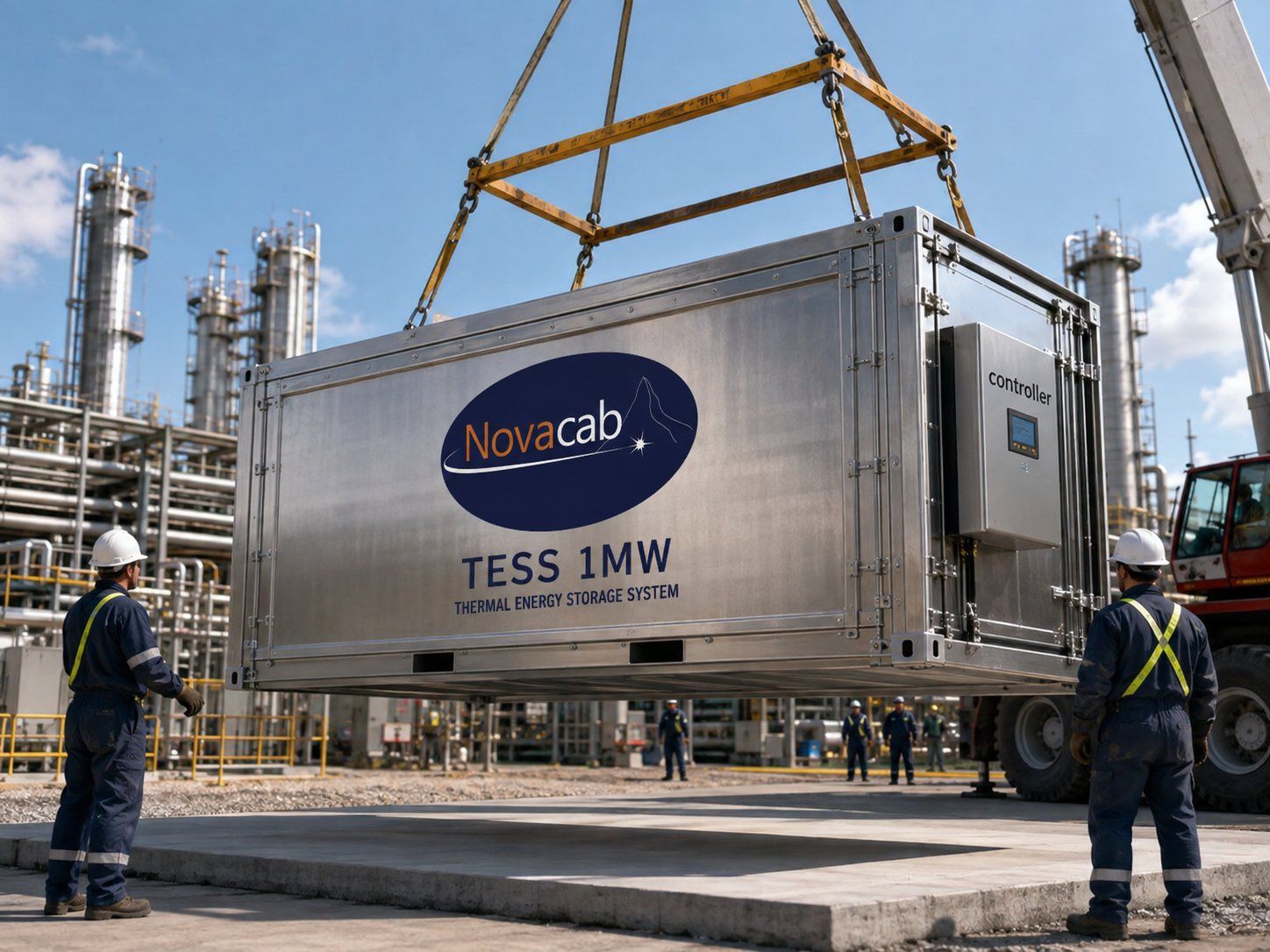
A Novacab TESS 1MW thermal energy storage unit being craned into place at an industrial plant, with installation crew guiding it onto its pad
A TESS 1MW unit arrives as a complete, factory-built battery — craned straight onto its pad and tied into the plant's heat-transfer loop.
Cutaway view of a Novacab TESS 1MW unit on the dock: blocks of SPCM ice store thermal energy delivered by a thermal fluid loop, with two ORC modules converting stored heat to electricity via a micro turbine
Inside a TESS 1MW unit: blocks of SPCM store the recovered BTUs, and each ORC module vaporizes its working fluid, spins a microturbine, condenses the vapor, and repeats the cycle.
Important distinction

Two coordinated phase-change processes are involved. The storage SPCM inside TESS melts and freezes to store and release heat. A separate ORC liquid/vapor working medium circulates in its own closed loop, vaporizing to drive the turbine and condensing afterward. The two media exchange heat but do not mix.

ORC is an add-on, not a requirement

Every TESS unit stores and releases heat on its own — that's the core function. The ORC modules shown above are what convert that stored heat into electricity, and they attach to the TESS as a separate module. A site that only needs thermal buffering or process-heat reuse can run TESS without ORC; a site that wants behind-the-meter power adds the ORC modules on top.

TESS thermal batteries are built, shipped, and craned onto rooftops and plant floors across North America. They arrive as complete units and integrate with the Sidel recovery chain upstream and the ORC conversion stage downstream — capturing heat at up to 800°F from the flue gas path and from vapour condensation and cooling-tower plume condensation, then holding it until the grid, the process, or the turbine calls for it.

Engineered range

One battery,
many temperature bands.

The Novacab TESS platform can be configured to harvest useful thermal energy from approximately 122°F (50°C) up to above 800°F (427°C). The applicable range for a given project depends on the programmed storage material, heat-transfer fluid, heat exchangers, ORC working fluid, turbine design, and required electrical output — engineered as matched temperature bands rather than one fluid or component set serving every job.

Thermal bandTypical source examplesTESS roleORC design emphasis
~122–250°FWarm process streams, hot water, low-grade recoveryAccumulate and stabilize low-grade heatLow-boiling working fluid and efficient condenser
~250–500°FEngine exhaust recovery, thermal oil, many industrial streamsStore heat at a programmed phase-change plateauMatched evaporator pressure and turbine inlet
~500°F to >800°FHigh-temperature exhaust, furnaces, solar thermal, industrial heatCapture higher-value heat with compatible materialsHigh-temperature fluid, metallurgy, pressure and safety design
One integrated energy pathway

Rejected or process heat → heat-transfer fluid → programmed TESS storage SPCM → controlled thermal hotplate → ORC liquid vaporization → microturbine rotation → generator electricity → condenser → liquid returned to the ORC pump. Actual performance is site-specific and depends on heat-source conditions, the selected SPCM and ORC fluid, and equipment efficiency — final claims are confirmed by engineering review and metered data.

Proven in the field

Real buildings.
Measured results.

Close to 400 Novacab TESS thermal batteries are already installed across Canada — in high-rises, hospitals, colleges, government datacenters, and community centres. A sample of the record:

SiteApplicationTESS deploymentMeasured result
Montreal Stock Exchange Tower48-level high-rise: offices, 2 commercial levels, 2 large datacenters — 2,500 tons of installed cooling2nd-generation TESS: 13 units for efficiency, 5 units for back-up+27% improvement on kW/ton; 6 MWh blackstart back-up battery
Louis Brier Hospital and Home265-bed hospital and long-term care facilityNovacab TESS thermal storage27% reduction in energy consumption
Édouard-Montpetit CollegeInstitutional building, chilled-water cooling — 800 tons of installed heating and cooling2nd-generation TESS: 5 units for efficiency and back-up28% reduction in energy consumption
Environment Canada / CMHCGovernmental datacenters, critical 24/7 operation — 400 tons of installed cooling2nd-generation TESS: 4 units for back-up+45% improvement in back-up capacity
Hearst Community CentreMulti-functional low-rise building, heating and cooling — 50 tons of installed HVAC3rd-generation TESS: 4 units for efficiency29% reduction in energy consumption
"The business benefits of climate action are clear. Companies that align their strategy with climate science — and quickly integrate low-carbon solutions — are best placed to thrive in a net-zero economy."
Stephane Bilodeau
Dr. Stephane Bilodeau, Eng., Ph.D., FECInventor of Novacab TESS · Smart Phases Inc.
← Previous stepSRU Flue Gas Condenser