INDUSTRY 03 · Waste Heat Recovery for Fossil Power — Gas & Coal
Power plant waste heat recovery.
Enormous value rejected through boiler and generator exhaust, condenser heat, cooling towers, blowdown and stack losses. Coal adds particulate.
Industry 03 · Power
Fossil-fuelled power: gas and coal.
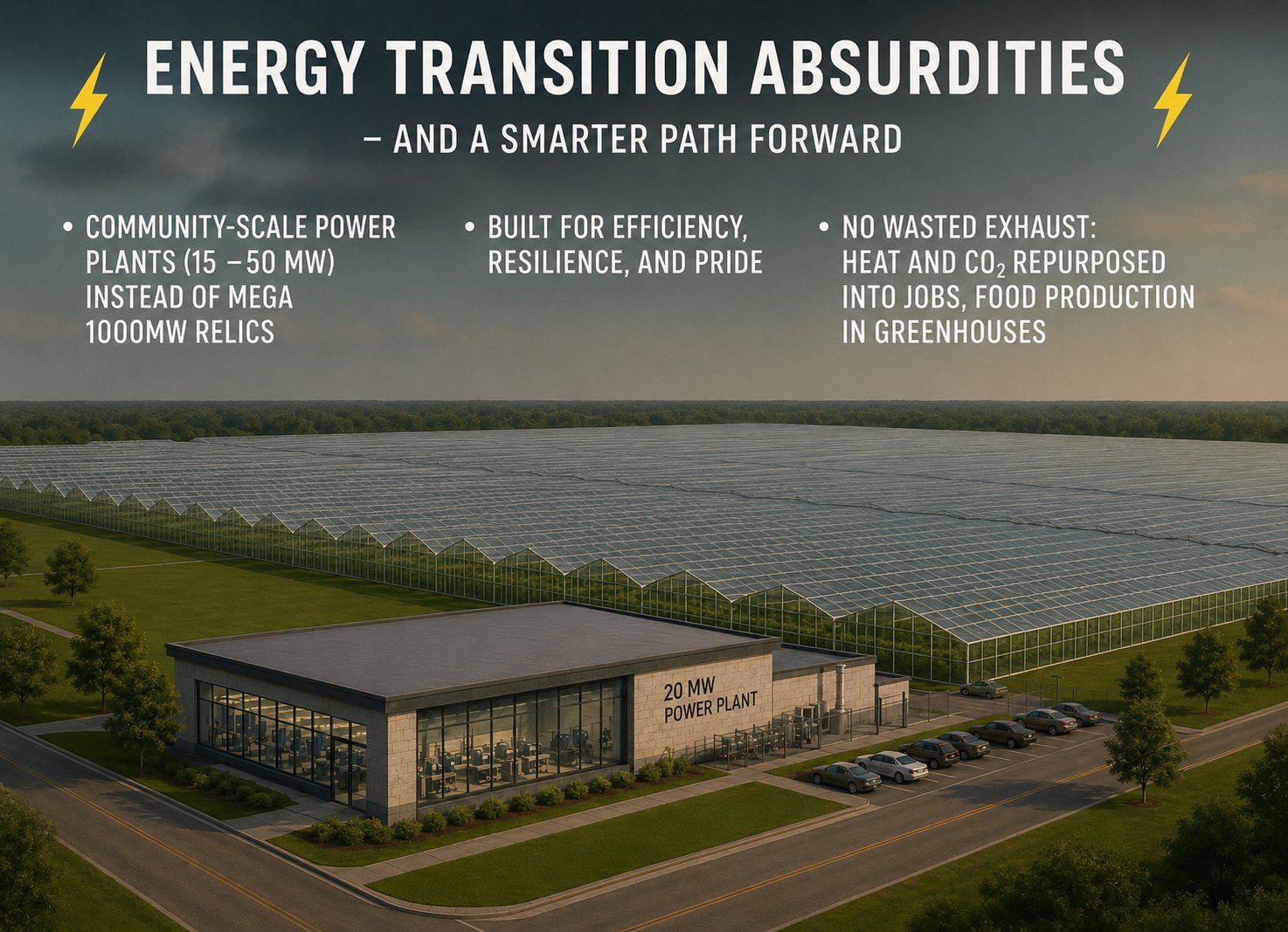
Power plants reject enormous value through boiler and generator exhaust, condenser heat, cooling towers, blowdown, stack losses and auxiliary systems. Where site conditions, fuel chemistry, emissions controls and independent measurement support it, this is a near-zero emissions opportunity — treated as an engineered project objective, not a regulatory guarantee, until it is demonstrated.
Case
Present setup & waste
SRU / RPC / TESS response
Target outcome
500 MW gas plant
Example output 12,000 MWh/day; fuel input may exceed 22,000–25,000 MWh(th)/day depending on heat rate. Waste: stack heat, condenser and cooling load, turbine exhaust, auxiliary losses.
SRU captures exhaust heat and water-vapour value where chemistry permits. TESS stores and reuses heat, and converts sufficient-temperature heat to behind-the-meter power. No RPC unless a particulate or fuel condition requires it.
Target 7–10% fuel reduction and ~25% useful output increase where integration supports it, plus black-start TESS backup for key plant infrastructure.
500 MW coal plant
Example output 12,000 MWh/day; fuel input may exceed 30,000 MWh(th)/day. Waste: particulate exhaust, stack heat, condenser heat, ash and solids, cooling-tower burden, auxiliary loads.
RPC addresses the particulate-heavy exhaust. SRU captures heat and water-vapour value where chemistry permits. TESS stores and converts recoverable thermal streams. Greenhouse or compression/condensation pathways create public-facing value.
Near-zero emissions opportunity when combined with proper emissions controls; 7–10% fuel reduction target, ~25% net MWh increase target, and 40–60% cooling-water reduction target where engineered and validated.
Infrastructure effects
Existing infrastructure used lessCooling-tower duty cycles, condenser thermal burden, auxiliary pumping, stack losses, fuel burn per net MWh, and diesel dependency for black-start functions.
New infrastructure addedTESS modules, SRU heat-recovery blocks, RPC particulate capture for solid fuels, heat exchangers, ducting, condensate treatment, controls, ORC/binary-cycle interfaces and measurement systems.
Black-start valueTESS can supply behind-the-meter backup from stored thermal energy for control systems, pumps, critical auxiliaries, communications and restart-support infrastructure — where the system is engineered for that duty.
Commercial approachStart with a measured 5–10 MW pilot rather than a 500 MW full-plant commitment. Prove metered fuel, water, output, emissions and uptime before scaling.
Where Sidel CREN fits — by fuel type
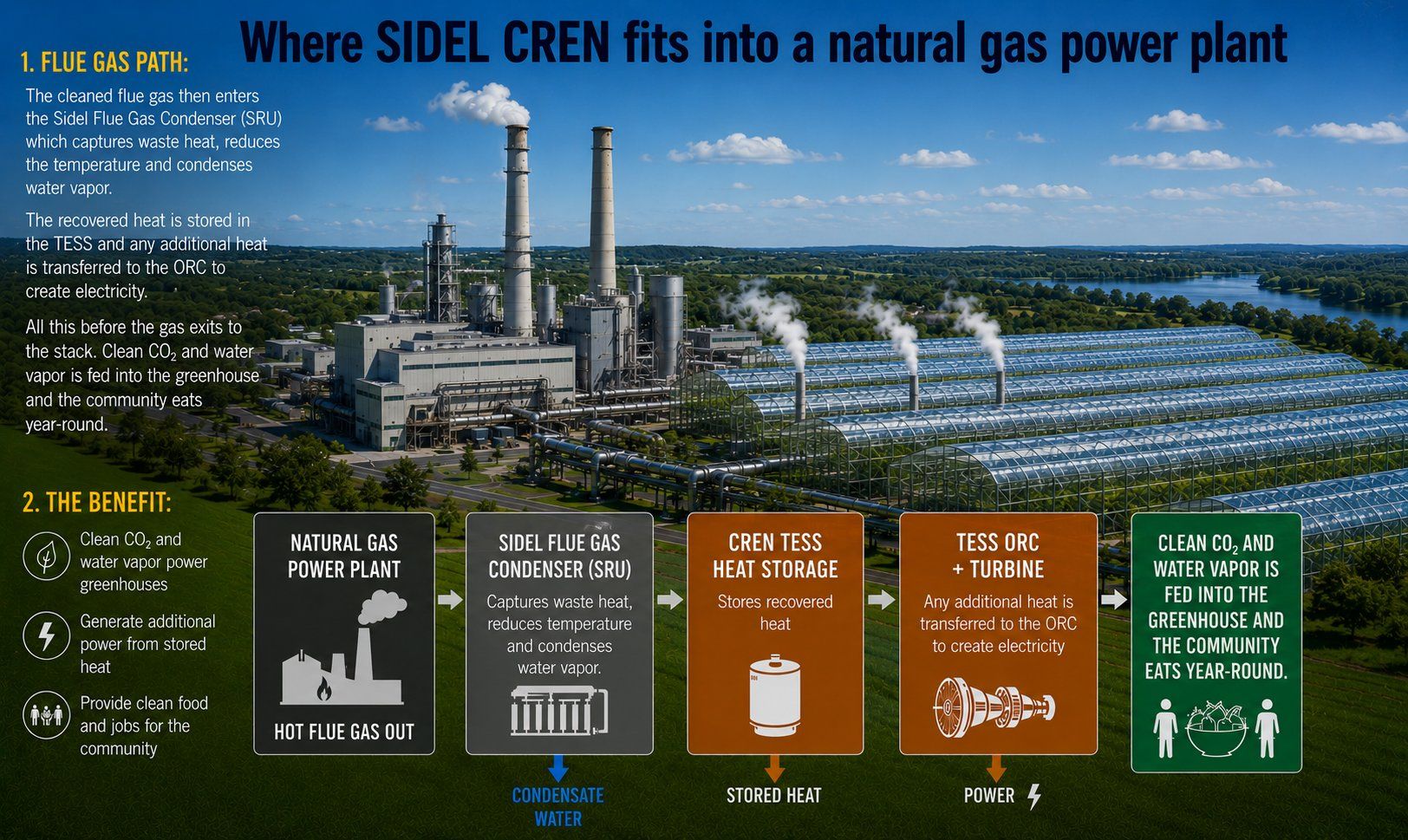
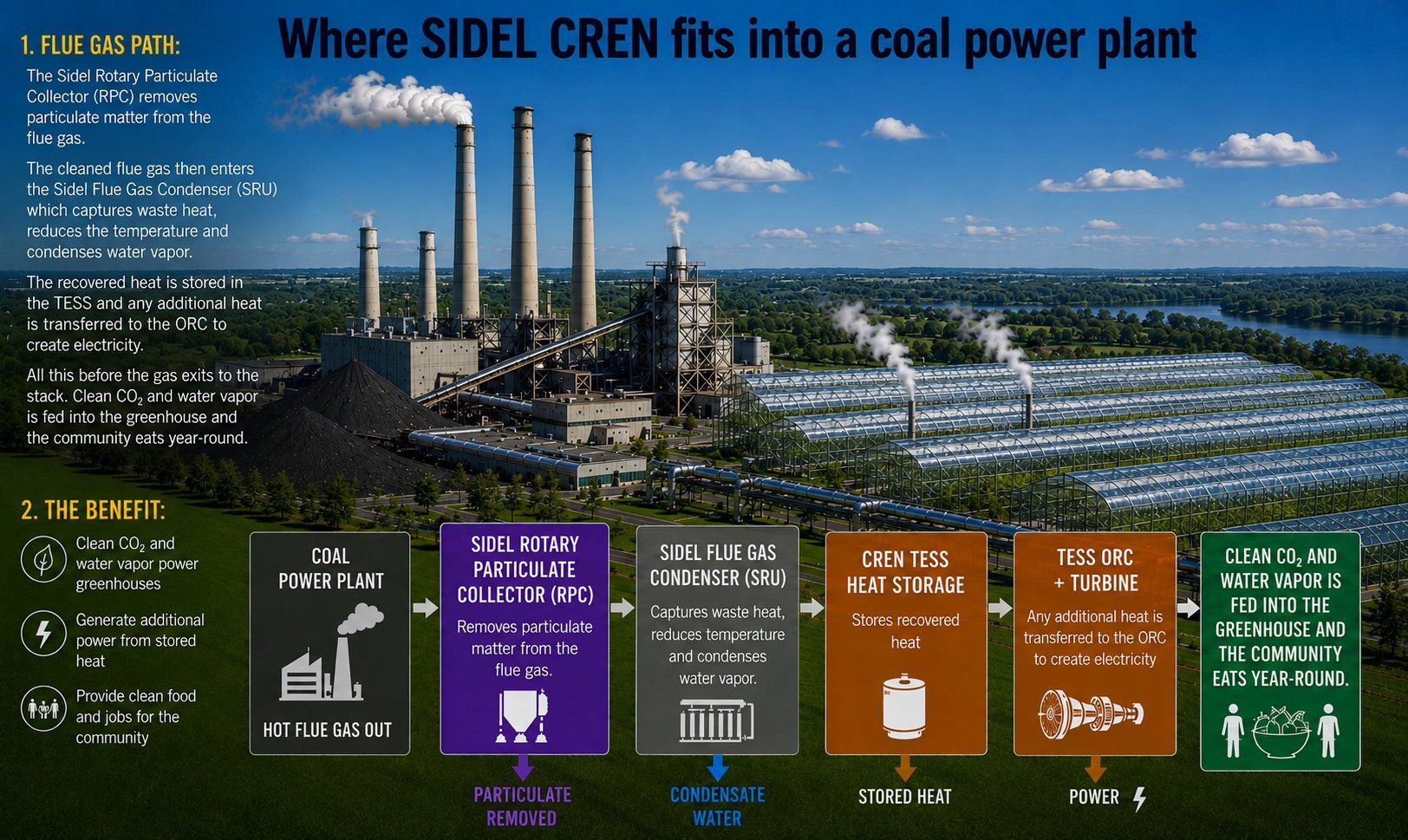
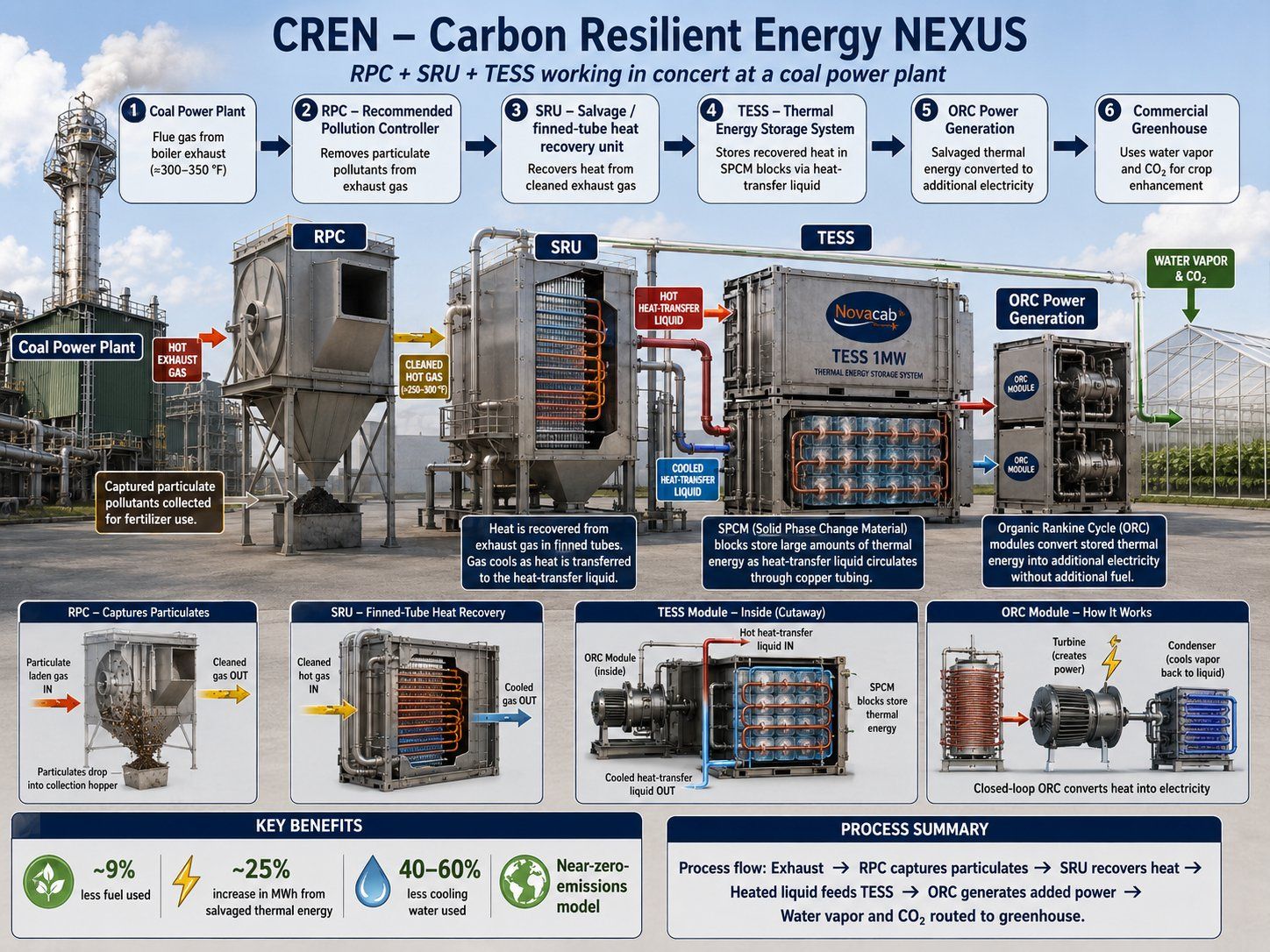
Natural gas: flue gas passes straight to the Sidel Flue Gas Condenser (SRU) — no RPC needed — then to CREN TESS heat storage and the ORC turbine, with clean CO₂ and water vapour feeding a greenhouse.Coal: the Sidel Rotary Particulate Collector (RPC) removes particulate matter first, then the same Flue Gas Condenser (SRU), CREN TESS heat storage and ORC turbine sequence applies before clean CO₂ and water vapour reach the greenhouse.
Texas concept · mixed-fuel coal + gas
The same plant, with the heat put back to work.
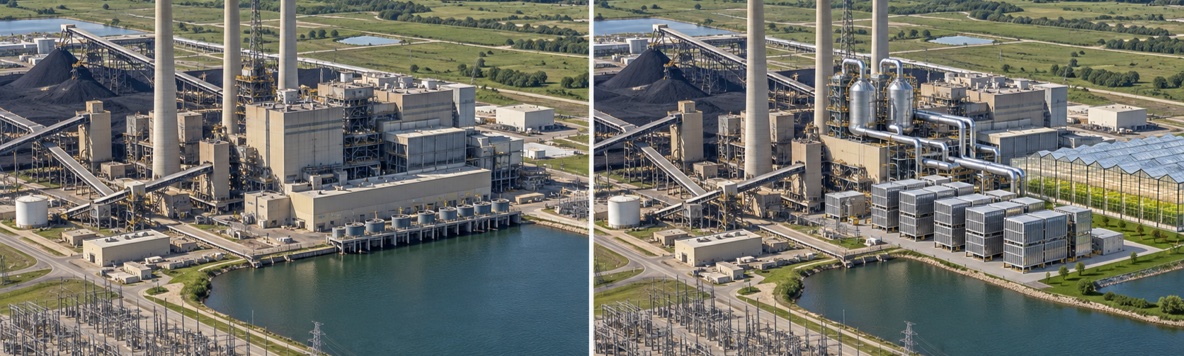
W.A. Parish, near Thompsons in Fort Bend County, is one of Texas's largest mixed-fuel stations: 3,632 MW reported, made up of 2,514 MW coal and 1,118 MW natural gas. We used it as a planning example of what the retrofit could add. On coal units, exhaust passes through the RPC before the SRU. TESS connects to the recovered-heat circuits, and the recovered heat, water and CO₂ can feed an agriculture link beside the plant.
Left: existing generation and controls, with remaining heat and water losses. Right: the RPC → SRU + TESS retrofit adds particle collection, heat recovery, thermal storage and a greenhouse link. Illustration only. It is not a photograph of Parish, an emissions measurement or a scale-verified layout.
Retrofit planning targets
Measure
As-is index
Proposed target
Fuel input
100
90–93
Net electricity
100
120–125
Fuel per MWh
100
72–77.5
Affected cooling water
100
40–60
Pollution
Measured baseline
Fewer particles; gas-specific controls retained
What a 100 MW gas plant could gain
Annual measure
Baseline
Target range
Net electricity
700,800 MWh
840,960–876,000 MWh
Gas consumption
6.307M MMBtu
5.676–5.866M MMBtu
Power receipts at $50/MWh
$35.04M
$42.05–43.80M
Fuel cost at $4/MMBtu
$25.23M
$22.71–23.47M
Target benefit: $8.8–11.3M per gas plant, per year
Extra electricity receipts plus fuel savings for a 100 MW plant at 80% utilization and a 9.0 MMBtu/MWh heat rate. The figure is before added O&M, debt, tax and carbon capture, and it is not EBITDA. Sensitivity: $5.5–17.8M/year across $30–80/MWh power and $3–6/MMBtu gas. The downside case (+5% MWh, −3% fuel) is $2.5M/year. The same heat is never counted twice across fuel savings, ORC generation and greenhouse heating.
Company planning targets, not unit-specific predictions
This assessment assumes no actual Parish fuel, generation, water or emissions baseline. RPC particle removal alone does not remove sulfur gases or CO₂, so required pollutant controls stay in place. Near-zero emissions would also require a separate carbon capture-and-storage pathway. The next step is a measured demonstration that meters fuel, net MWh, water and pollutant mass emissions.
The coal end-state
Emissions transformed, not just permitted.
RPC removes the solid pollutants. SRU and TESS strip the Btus across an 800°F-to-122°F cascade and convert what qualifies into behind-the-meter electricity. What remains — CO₂ and water vapour — becomes the input to a greenhouse complex producing food year-round.
Byproduct utilization — coal
The RPC turns fly ash into a feedstock, not a liability.
The Sidel RPC removes fine particulate — unburned fixed carbon and fly ash — from coal-plant flue gas before it reaches the stack. Today that material is typically landfilled at the plant's expense. Once separated and characterised, it's a consistent, sized, reusable industrial feedstock: a stable mix of unburned fixed carbon and fine mineral residue (silica, alumina and metal oxides).
RPC + SRU + TESS + ORC working in concert at a coal power plant: particulate is captured, heat is recovered and stored, and additional electricity is generated before clean CO₂ and water vapour reach the greenhouse.
Established uses for captured fixed-carbon ash
Cement manufacturingBlended with raw material as a supplementary ingredient — an established buyer base in India's cement sector.
High-refractory bricksUsed in bricks requiring a high refractory index for furnace and kiln linings.
Sterile abrasive cleanerFunctions as an effective, sterile abrasive for industrial surface cleaning.
Insulation materialLow thermal conductivity makes it a solid input for insulation products.
Construction site bufferFilled into sand bags to create a lightweight buffer on open construction sites.
Wildfire suppression & industrial absorbentEffective for dousing and smothering fires, and for absorbing spilled fluids on facility floors.
Turning a cost center into a revenue line
Material otherwise landfilled at the plant's expense is diverted to a paying market across cement, refractories, abrasives, insulation, construction and emergency response — one captured feedstock, many buyers. Modeled on published industry data for a representative 500 MW coal-fired plant: ~1.4M tons of coal burned per year generates ~125,000 tons of ash, of which ~100,000 tons is fine particulate available for RPC capture. At current fly-ash market prices of roughly $40–$122/ton, that models to $4M–$12M+/year in potential revenue — a benchmark to refine against plant-specific ash characterization and buyer specifications, not a quote.
Before we quote anything
The data we ask for — power.
We would rather send you a data request than a brochure. This is what turns a conversation into a bankable project.
Gas plant
Plant heat rate; turbine and exhaust temperature and flow; cooling technology and water balance; auxiliary load; dispatch profile; power price; emissions permit; black-start requirements; interconnection limits; available footprint.
Coal plant
Coal quality; ash and particulate loading; flue-gas chemistry; existing ESP / baghouse / FGD / SCR controls; boiler data; condenser and cooling-tower water balance; auxiliary load; ash handling; corrosion and condensate constraints; emissions permits.
Validation boundary
All claims relating to site savings, water reduction, output increase, emissions outcomes, payback, incentives and deployment economics are planning assumptions, analogues or prior-project references — unless and until they are validated for your specific facility through engineering, measurement, vendor quotation, financing documentation, legal review and final commercial agreements.