INDUSTRY 06 · Waste Heat Recovery for Concrete Manufacturing
Concrete plant waste heat recovery.
Curing is the single largest energy draw in a precast plant — boilers, curing chambers, hot condensate and batch-water cooling all running at the same time production is active.
Industry 06 · Concrete
Concrete manufacturing: two very different thermal profiles.
A transit-mix ready-mix plant is genuinely light on stationary thermal energy — batching, mixers, pumps and delivery logistics dominate, not boilers. Precast, prestressed, pipe and block plants are a different animal: DOE/EPA ENERGY STAR benchmarks show curing alone at roughly 44% of a precast plant's energy use, on a site-energy intensity nearly ten times higher per unit of product than ready-mix. That's the profile where SRU, RPC and TESS have real work to do.
Planning basis
Ready-mix (NRMCA national average)
Precast / concrete products (DOE/EPA)
Reference production
62,207 yd³/yr (489-plant NRMCA benchmark)
Same volume, precast-intensity profile
Purchased electricity
200 MWh/yr (3.22 kWh/yd³)
1.80 GWh/yr (~29 kWh/yd³)
Total purchased site energy
4,334 MMBtu/yr
36,932 MMBtu/yr (593.7 kBtu/yd³; curing ~44% of that)
Estimated final heat rejection
~3,034–3,901 MMBtu/yr (70–90% of purchased energy)
~25,853–33,239 MMBtu/yr
Screening-level TESS-addressable heat
~433–1,084 MMBtu/yr
~7,386–16,620 MMBtu/yr
Source: National Ready Mixed Concrete Association (NRMCA) national benchmark dataset; U.S. DOE/EPA ENERGY STAR Energy Efficiency Improvement and Cost Saving Opportunities for the Concrete Industry. TESS-addressable ranges are engineering screening assumptions, not measured statistics — a thermal audit verifies temperature, flow and access before sizing.
Where TESS fits in a concrete plant
Waste area
How the waste happens today
Technology response
Boiler & curing-chamber exhaust
Steam curing is the single largest energy draw in a precast plant; stack and chamber heat is rejected continuously.
SRU + TESS capture and store the recovered Btus; RPC where solid-fuel or particulate exhaust applies.
Hot condensate & compressor heat
Condensate return losses and compressor discharge heat are typically vented rather than reused.
TESS captures and buffers this heat for direct reuse in curing or hot-water production.
Batch-water & aggregate cooling
Hot-weather concrete temperature control draws chiller and ice-plant electricity in sharp peaks.
Cold-side TESS storage shifts and reduces chiller/ice-plant load.
Cyclical boiler & chiller operation
Equipment cycles around short-duration peaks instead of running at efficient steady state.
TESS thermal buffering lets boilers and chillers operate closer to steady state.
Grid disruption & demand charges
Mixers, pumps, compressors and material handling create electrical peaks with no thermal backstop.
Where engineered for it, stored heat supports islanding and critical-load backup for controls, pumps and curing systems.
Concrete — qualification screen
The strongest fit is precast, prestressed, pipe, block or masonry production (not a small transit-mix-only yard) at roughly 150,000 yd³/year or more, with a boiler, curing exhaust, hot condensate, compressor discharge or other accessible heat source running consistently above the TESS/ORC minimum temperature threshold, at least 4,000 operating hours/year, meaningful demand charges or resilience need, and material-temperature control through hot or chilled water. A planned capacity expansion that would otherwise mean new boilers or chillers is also a strong signal.
Concrete — first pilot
Start with the single largest continuous thermal stream — usually the curing boiler or chamber. Meter the baseline for 2–4 weeks, install a bypassable pilot, verify direct heat reuse and/or ORC output for 30–90 days, then evaluate cold-side storage for batch-water and aggregate cooling before scaling further.
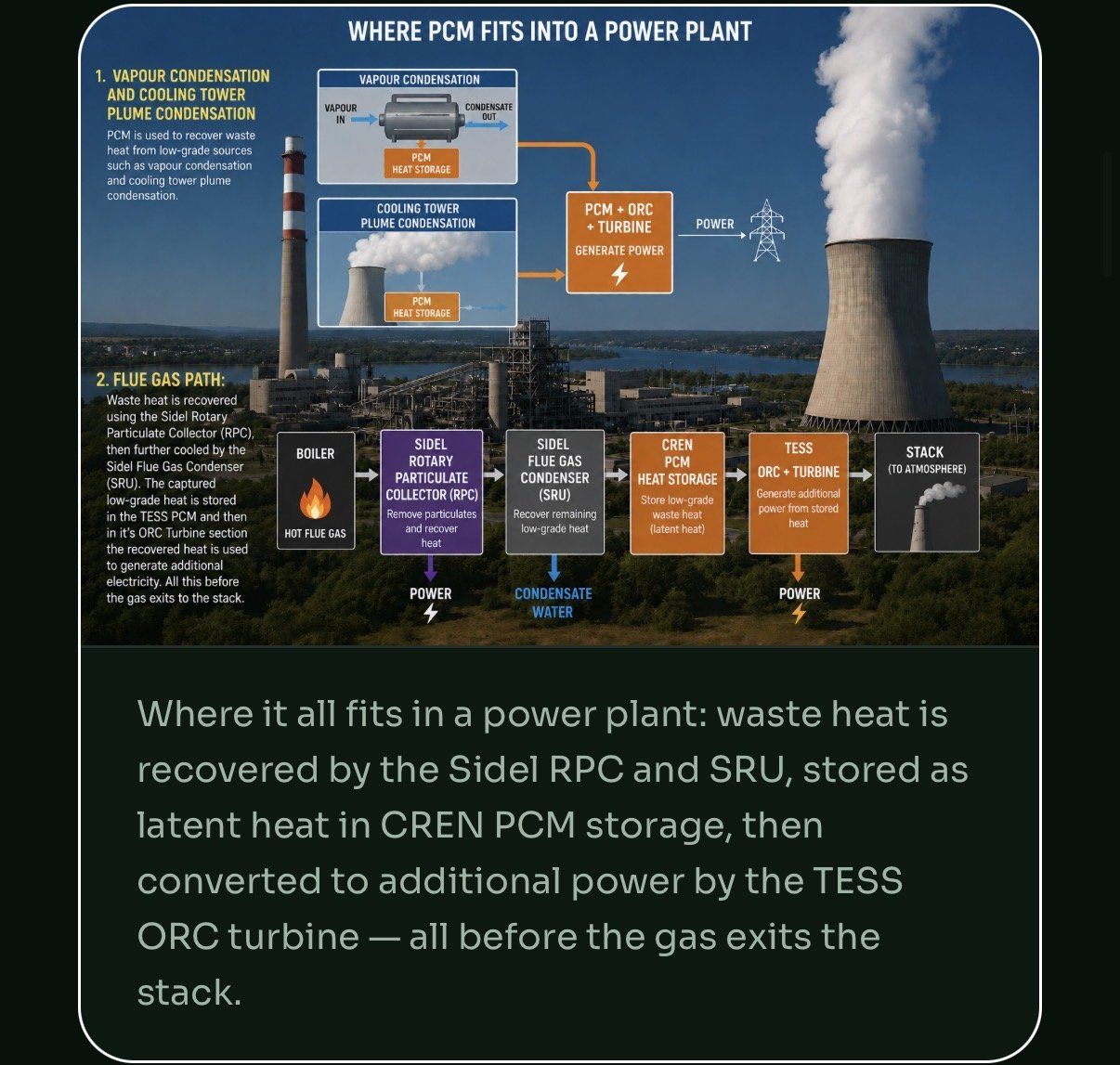
How it fits: curing boiler exhaust passes through the SRU (RPC only if solid fuel applies), heat is stored in TESS, and the ORC turbine converts what qualifies into additional power — before the gas exits the stack.
Before we quote anything
The data we ask for — concrete.
We would rather send you a data request than a brochure. This is what turns a conversation into a bankable project.
Production volume and mix (ready-mix vs. precast/pipe/block share); boiler and curing-chamber schedule, fuel type and temperatures; compressor and chiller kW; batch-water and aggregate heating/cooling loads; electricity interval data and demand-charge structure; water purchase and discharge volumes; operating hours and shift pattern; any planned capacity expansion.
Validation boundary
All claims relating to site savings, water reduction, output increase, emissions outcomes, payback, incentives and deployment economics are planning assumptions, analogues or prior-project references — unless and until they are validated for your specific facility through engineering, measurement, vendor quotation, financing documentation, legal review and final commercial agreements.