Aerial view of a heavy industrial plant
INDUSTRIES · Dairy · Sugar · Fossil Power · Steel & Metals

Four industries.
One thermal problem.

Every one of them buys fuel, converts it to heat, uses a fraction of it, and rejects the rest through stacks, condensers and cooling towers. That rejected energy is already paid for. We recover it, store it, reuse it, and convert it.

Where the platform fits

Pick your plant.

Industry 01

🥛 Large Dairy

A 365-day heat-and-cooling machine: milk reception, chilling, pasteurisation, CIP, drying, cold storage, boilers, generators and effluent.

Dairy detail →
Industry 02

🌾 Sugar Mill

A thermal plant with a product attached — bagasse boilers, evaporation, batch pans, vacuum systems, spray ponds and condenser water.

Sugar detail →
Industry 03

⚡ Fossil Power — Gas & Coal

Enormous value rejected through boiler and generator exhaust, condenser heat, cooling towers, blowdown and stack losses. Coal adds particulate.

Power detail →
Industry 04

🏗️ Steel & Metals

The strongest long-term market — multiple high-grade and low-grade streams across furnaces, coke/sinter, EAF, rolling, quench and off-gas.

Steel detail →
How to read this page

The figures below are planning-level references drawn from real reference plants and engineering analysis. They are here to show the scale of the opportunity and the questions worth asking — not to quote your site. Every number becomes a real number only after metered baselines, a site thermal map, and third-party measurement. That discipline is the whole point of our approach.

Industry 01

Large dairy:
heat and cold, all day, every day.

A large dairy runs 365 days a year and pays twice on nearly every process — once to heat the product, then again to cool it. Milk handling, chilling, pasteurisation, hot water, CIP, evaporation, drying, refrigeration, cold rooms, boilers, generators and effluent systems create exactly the thermal profile where SRU + RPC + TESS deliver value.

Planning basisReference valueWhat it implies
Milk handling capacity3.0–3.5 million litres/dayHigh continuous cooling load; milk reception creates shock loads.
Steam demand20–25 TPH — roughly 360–450 MWh(th)/day depending on steam conditions and scheduleMajor boiler fuel and stack-loss opportunity; a strong candidate for SRU + TESS.
Refrigeration~1,500 TR — roughly 24–36 MWh(e)/day of compressor powerTESS can buffer refrigeration peaks and cold-storage swings.
Current waste streamsBoiler stack losses, condensate losses, refrigeration condenser heat, cooling-tower rejection, pasteurisation heat/cool cycling, CIP and dryer exhaustMore than half of purchased energy may be rejected as waste heat or unmanaged cooling demand when thermal streams are not integrated.

Dairy waste-energy map

Waste areaHow the waste happens todayTechnology response
Boiler & steamStack losses, blowdown, condensate losses, cycling, steam traps, unbalanced hot-water loads.SRU + TESS recover and buffer heat; RPC where solid fuel or particulate exhaust applies.
PasteurisationProduct is heated then immediately cooled; repeated cycling creates load swings.TESS stabilises hot/cold demand and shifts recovered heat to CIP or preheat.
Refrigeration & cold storageCompressor heat is rejected to condenser and cooling tower; peak loads drive demand charges.TESS buffers chilled water and cold storage, and reduces compressor peaks.
Milk reception & chillingIncoming milk creates shock loads at reception and during peak procurement windows.TESS acts as a thermal shock absorber for consistent chilling and product quality.
Drying / milk powderDrying exhaust and heated air streams reject large amounts of heat.Recover heat for preheat, staged drying-air use, or behind-the-meter conversion where heat quality allows.
Dairy — first pilot

Select one high-load island: boiler, CIP, pasteurisation or refrigeration. Meter the baseline for 2–4 weeks, install a bypassable pilot, verify savings for 30–90 days, then scale once the cash, quality, water and reliability benefits are proven.

Industry 02

Sugar mill:
a thermal plant with a product attached.

Batch-pan crystallisation and condenser/spray-pond systems represent the largest concentration of recoverable and stabilisable thermal load in the mill. The reference case below is a 14,000 TCD mill on a 110-day season.

Reference itemPreliminary valueMeaning for deployment
Plant scale14,000 TCD; 560 TPH average crushing; 110-day operating seasonLarge seasonal thermal and cooling load — a strong candidate for an instrumented pilot.
Boiler & power230 TPH boiler; 44 MW turbine; 41 MW generation; 26 MW exportOpportunity to stabilise process heat and improve internal energy use. Higher-temperature streams should be assessed for power conversion.
Batch-pan thermal load132.8 MW(th) gross vapour load; 55.1 MW(th) recoverable/stabilisable under analysis assumptionsValue is strongest around condenser and spray-pond relief, vacuum stability, and process stabilisation.
Cooling / contact-water handling13.26 million m³/season-equivalent reduction in recirculated and contact-water handlingThis is not one-for-one fresh-water saving. Makeup, blowdown, evaporation and wastewater meters must confirm the real water benefit.
Pilot scale4–6 TESS units on one representative pan; full batch-pan sizing is 48 TESS unitsThe pan pilot is the correct entry point — full mill deployment is a staged, financed programme, not a first step.

What changes on the floor

Sugar — first pilot

Target one representative high-load or problem pan. Use 4–6 TESS units after a piping survey and strike profile, then meter vacuum stability, vapour flow, spray-pond temperature, pump kW, strike duration, crystal size, molasses purity, sugar recovery and wastewater.

Industry 03

Fossil-fuelled power:
gas and coal.

Power plants reject enormous value through boiler and generator exhaust, condenser heat, cooling towers, blowdown, stack losses and auxiliary systems. Where site conditions, fuel chemistry, emissions controls and independent measurement support it, this is a near-zero emissions opportunity — treated as an engineered project objective, not a regulatory guarantee, until it is demonstrated.

CasePresent setup & wasteSRU / RPC / TESS responseTarget outcome
500 MW gas plant Example output 12,000 MWh/day; fuel input may exceed 22,000–25,000 MWh(th)/day depending on heat rate. Waste: stack heat, condenser and cooling load, turbine exhaust, auxiliary losses. SRU captures exhaust heat and water-vapour value where chemistry permits. TESS stores and reuses heat, and converts sufficient-temperature heat to behind-the-meter power. No RPC unless a particulate or fuel condition requires it. Target 7–10% fuel reduction and ~25% useful output increase where integration supports it, plus black-start TESS backup for key plant infrastructure.
500 MW coal plant Example output 12,000 MWh/day; fuel input may exceed 30,000 MWh(th)/day. Waste: particulate exhaust, stack heat, condenser heat, ash and solids, cooling-tower burden, auxiliary loads. RPC addresses the particulate-heavy exhaust. SRU captures heat and water-vapour value where chemistry permits. TESS stores and converts recoverable thermal streams. Greenhouse or compression/condensation pathways create public-facing value. Near-zero emissions opportunity when combined with proper emissions controls; 7–10% fuel reduction target, ~25% net MWh increase target, and 40–60% cooling-water reduction target where engineered and validated.

Infrastructure effects

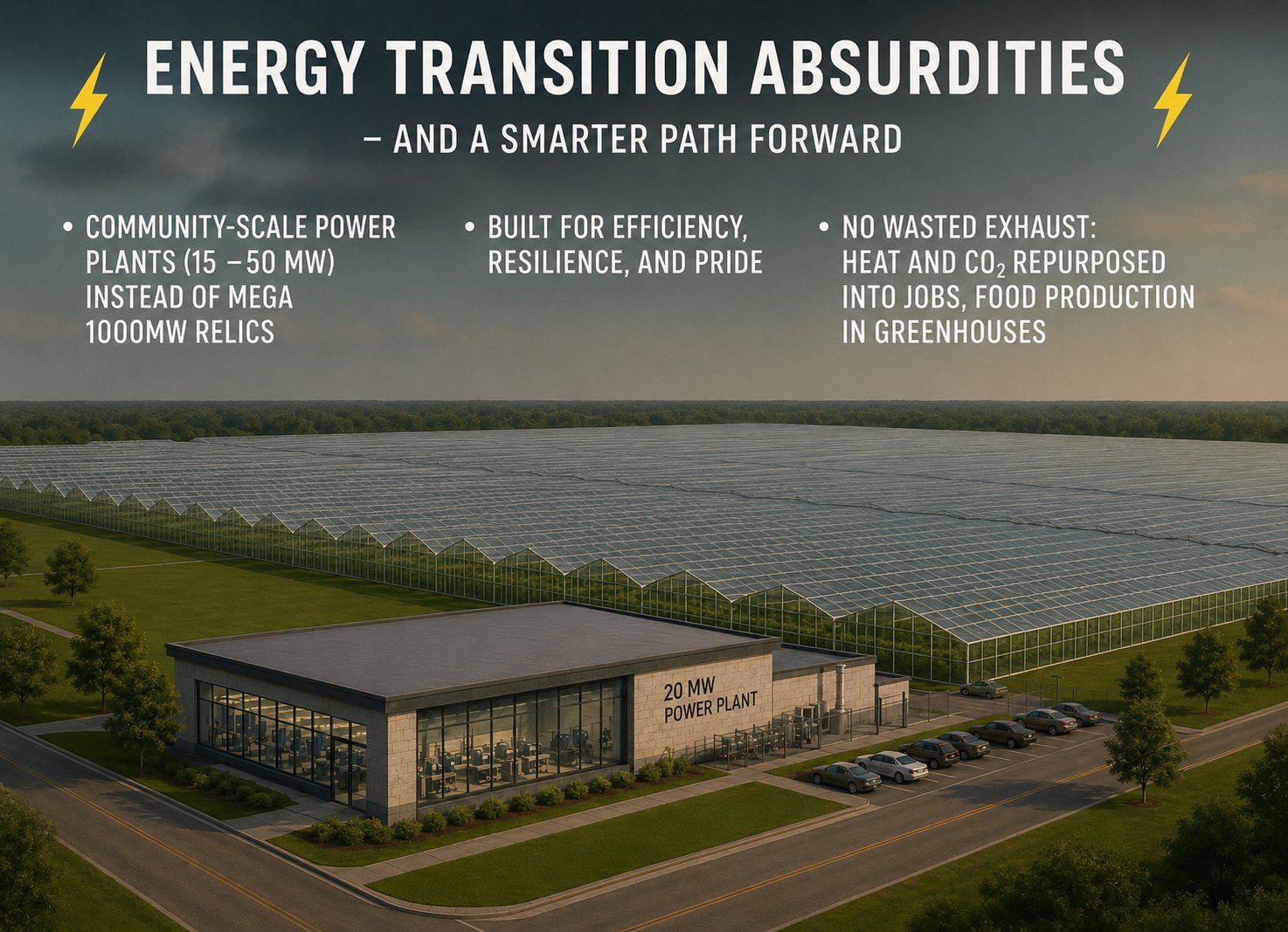
Power plant integrated with a greenhouse campus
The coal end-state

Emissions transformed,
not just permitted.

RPC removes the solid pollutants. SRU and TESS strip the Btus across an 800°F-to-122°F cascade and convert what qualifies into behind-the-meter electricity. What remains — CO₂ and water vapour — becomes the input to a greenhouse complex producing food year-round.

Industry 04

Steel & metals:
the deepest heat map of all.

Steel and metals facilities are among the strongest long-term markets because they contain multiple high-grade and low-grade thermal streams at once — furnaces, reheating, coke and sinter, hot rolling, EAF, heat treatment, boilers, gas cleaning, off-gas, dust collection, quench and cooling loops, cooling towers and wastewater systems.

AreaWaste or pain pointTechnology fitExpected result to measure
Furnaces / reheating / hot rollingHigh-temperature exhaust and radiant losses; repeated heating and thermal cycling.TESS + heat exchangers; SRU where exhaust chemistry permits.Reduced fuel per tonne, recovered heat for preheat and process use, steadier throughput, fewer thermal shocks.
Coke / sinter / solid-fuel operationsParticulate-heavy exhaust, visible emissions, ash and solids, heat rejection.RPC + SRU/TESS integration after an emissions chemistry review.Particulate capture, lower visible emissions, heat recovery, and possible by-product handling value.
EAF / electric-intensive operationsLarge electrical peaks, off-gas heat, cooling-water stress and downtime risk.TESS for thermal buffering and power recovery; ORC/binary cycle where heat quality supports it.Peak reduction, recovered energy value, cooling-water relief, and resilience.
Cooling / quench / water systemsHigh water throughput, evaporation, blowdown, treatment cost, thermal pollution and pump load.TESS plus system redesign to reduce thermal rejection and reuse heat.Water savings, lower pumping power, reduced chemical and treatment burden.
Dust collection / boiler house / utilitiesParticulate and stack losses; inefficient utility support systems.RPC for particulates, SRU for suitable flue gas, TESS for storage and reuse.Cleaner utility operation, lower fuel use, less wasted energy.
Steel & metals — first pilot

Start with a mapped heat-stream pilot: 5–10 TESS plus 1–2 SRU/RPC blocks depending on furnace, boiler, fuel and exhaust chemistry. Full-site economics are only presented after the actual waste-heat streams, cooling systems, particulate sources and operating priorities have been mapped.

Cross-industry

What gets used less.
What gets added.

Regardless of sector, a Sidel CREN retrofit shifts the same five categories.

CategoryExisting infrastructure reduced in useNew infrastructure added
Thermal rejectionCooling-tower duty cycles, spray ponds, condenser thermal load, plume, evaporation, makeup water, blowdown and chemical treatment.TESS/SPCM modules, heat exchangers, recovery headers, piping, thermal controls, and measurement & verification.
Boilers & steamFuel firing rate, cycling, stack heat loss, blowdown burden, steam venting, hot-water dumping and manual steam balancing.SRU flue-gas condenser and heat exchanger, condensate handling, hot-water or makeup-water preheat, and a TESS thermal buffer.
Cooling & chillingChiller and compressor runtime, peak electrical demand, refrigeration shocks, cold-storage swings and emergency utility intervention.TESS cold and thermal storage, controls, demand-response logic and a critical-load backup strategy.
Emissions & solidsVisible particulate burden and incomplete capture pathways for coal, biomass, wood, waste and fuel oil streams.RPC particulate capture, engineering-selected back-end emissions controls, ducting, instrumentation and compliant ash/by-product handling.
Power & resilienceGrid exposure, diesel backup dependency for controls and auxiliaries, and lost production during outage and restart events.Behind-the-meter generation from heat above ~53–55 °C where viable, ORC/binary-cycle interface, controls and black-start support design.
Before we quote anything

The data we ask for.

We would rather send you a data request than a brochure. This is the list that turns a conversation into a bankable project.

IndustryCritical data required before quoting final savings
DairyMonthly utility bills; boiler fuel and steam logs; stack temperatures; pasteurisation and CIP schedules; refrigeration compressor kW; cooling-tower makeup and blowdown; dryer heat data; product loss and spoilage; water and wastewater cost; site layout.
SugarPan vapour flow, pressure and temperature; strike cycles; vacuum stability; spray-pond and condenser data; pump kW; boiler data; bagasse value; sugar recovery; molasses purity; crystal size; water intake and wastewater; production schedule.
Gas power plantPlant heat rate; turbine and exhaust temperature and flow; cooling technology and water balance; auxiliary load; dispatch profile; power price; emissions permit; black-start requirements; interconnection limits; available footprint.
Coal power plantCoal quality; ash and particulate loading; flue-gas chemistry; existing ESP / baghouse / FGD / SCR controls; boiler data; condenser and cooling-tower water balance; auxiliary load; ash handling; corrosion and condensate constraints; emissions permits.
Steel & metalsFurnace and off-gas temperature and flow; dust and particulate loading; EAF, reheat and rolling schedules; cooling and quench water; boiler house; power tariff; production bottlenecks; downtime; quality loss; maintenance cost; space and shutdown windows.
Validation boundary

All claims relating to site savings, water reduction, output increase, emissions outcomes, payback, incentives and deployment economics are planning assumptions, analogues or prior-project references — unless and until they are validated for your specific facility through engineering, measurement, vendor quotation, financing documentation, legal review and final commercial agreements.

← How we workOur Approach