A 365-day heat-and-cooling machine: milk reception, chilling, pasteurisation, CIP, drying, cold storage, boilers, generators and effluent — all paying for heat twice.
Industry 01 · Dairy
Large dairy: heat and cold, all day, every day.
A large dairy runs 365 days a year and pays twice on nearly every process — once to heat the product, then again to cool it. Milk handling, chilling, pasteurisation, hot water, CIP, evaporation, drying, refrigeration, cold rooms, boilers, generators and effluent systems create exactly the thermal profile where SRU + RPC + TESS deliver value.
Planning basis
Reference value
What it implies
Milk handling capacity
3.0–3.5 million litres/day
High continuous cooling load; milk reception creates shock loads.
Steam demand
20–25 TPH — roughly 360–450 MWh(th)/day depending on steam conditions and schedule
Major boiler fuel and stack-loss opportunity; a strong candidate for SRU + TESS.
Refrigeration
~1,500 TR — roughly 24–36 MWh(e)/day of compressor power
TESS can buffer refrigeration peaks and cold-storage swings.
SRU + TESS recover and buffer heat; RPC where solid fuel or particulate exhaust applies.
Pasteurisation
Product is heated then immediately cooled; repeated cycling creates load swings.
TESS stabilises hot/cold demand and shifts recovered heat to CIP or preheat.
Refrigeration & cold storage
Compressor heat is rejected to condenser and cooling tower; peak loads drive demand charges.
TESS buffers chilled water and cold storage, and reduces compressor peaks.
Milk reception & chilling
Incoming milk creates shock loads at reception and during peak procurement windows.
TESS acts as a thermal shock absorber for consistent chilling and product quality.
Drying / milk powder
Drying exhaust and heated air streams reject large amounts of heat.
Recover heat for preheat, staged drying-air use, or behind-the-meter conversion where heat quality allows.
Dairy — first pilot
Select one high-load island: boiler, CIP, pasteurisation or refrigeration. Meter the baseline for 2–4 weeks, install a bypassable pilot, verify savings for 30–90 days, then scale once the cash, quality, water and reliability benefits are proven.
Sidel Systems USA's SRU flue-gas condenser already runs on this exact thermal profile at Darigold's Jerome and Boise plants — see the SRU client list and case studies.
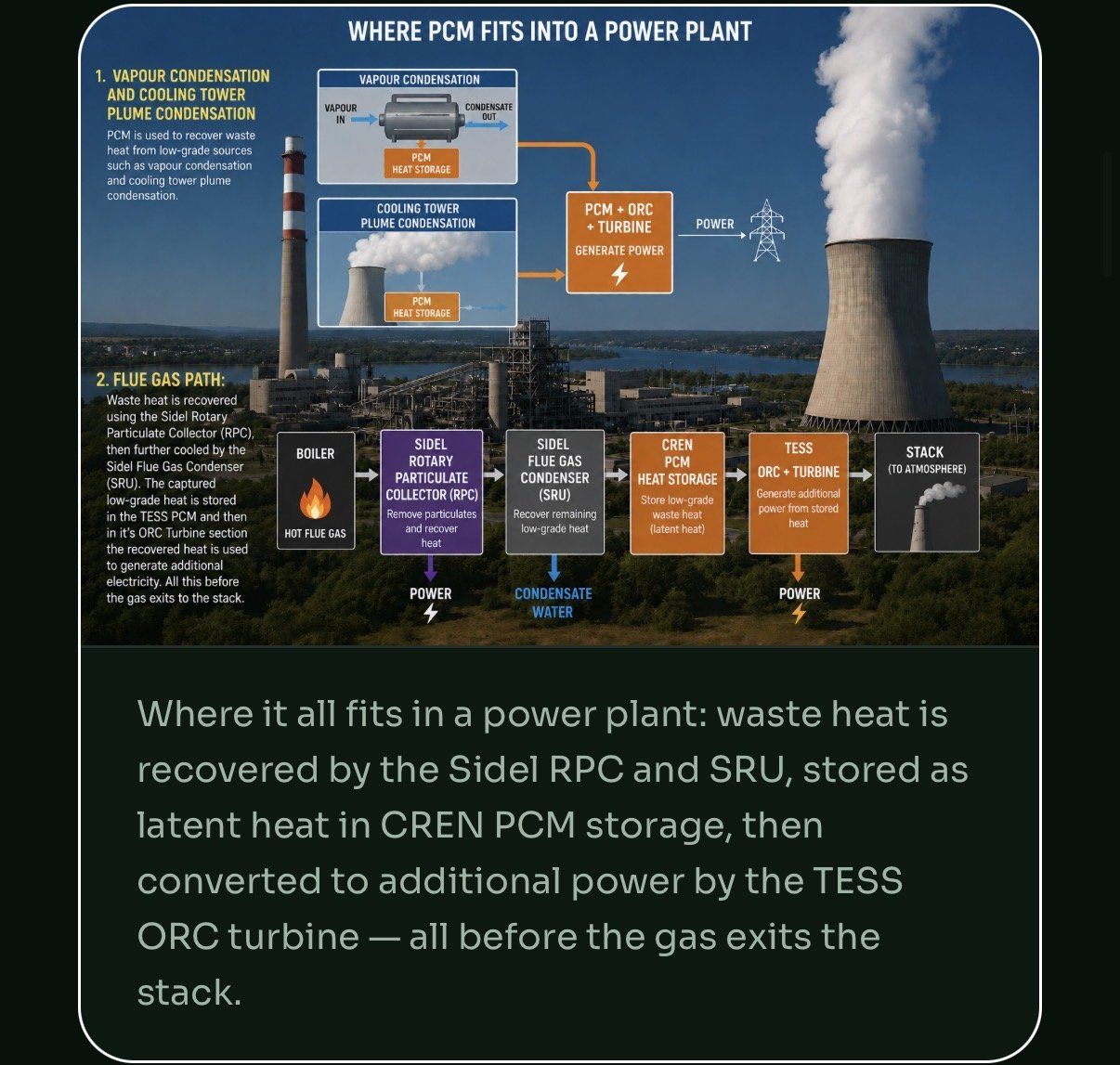
How it fits: boiler exhaust passes through the SRU (RPC only if solid fuel applies), heat is stored in TESS, and the ORC turbine converts what qualifies into additional power — before the gas exits the stack.
Before we quote anything
The data we ask for — dairy.
We would rather send you a data request than a brochure. This is what turns a conversation into a bankable project.
Monthly utility bills; boiler fuel and steam logs; stack temperatures; pasteurisation and CIP schedules; refrigeration compressor kW; cooling-tower makeup and blowdown; dryer heat data; product loss and spoilage; water and wastewater cost; site layout.
Validation boundary
All claims relating to site savings, water reduction, output increase, emissions outcomes, payback, incentives and deployment economics are planning assumptions, analogues or prior-project references — unless and until they are validated for your specific facility through engineering, measurement, vendor quotation, financing documentation, legal review and final commercial agreements.