
Start with steam on cane: the weight of steam your process uses for each weight of cane crushed. Cut it and the same bagasse makes more surplus power. One published study treats a mill as efficient below 50 percent, and as able to cogenerate power for sale below 40 percent. The usual savings are in the evaporators, heaters and vacuum pans, and in the wet bagasse itself.
A sugar mill is a thermal plant with a product attached. Cane goes in, juice is pressed out, and the fibre left behind, called bagasse, is burned to raise steam. That steam drives turbines and heats the process. Because the fuel is a by-product, it is easy to treat energy as free. It is not. Bagasse burned for process steam cannot be used to make electricity for export or sold for other uses.
Start with one number: steam on cane
Steam on cane, or SOC, is the weight of steam used per weight of cane crushed. It is the standard yardstick for mill energy efficiency. The lower it is, the less bagasse the process needs.
A study of an Indonesian white-sugar mill, published in Jurnal Rekayasa Proses, puts the benchmarks this way:
- Below 50 percent SOC, a mill can run on its own bagasse. Above it, the mill needs extra fuel.
- Below 40 percent SOC, a mill can cogenerate and sell electricity.
These are one study's rules of thumb for one type of mill. Your own figure depends on your process, your season and your equipment. So the first job is simply to measure it.
Where the steam goes
In a typical raw or white sugar process, most steam goes to a few places.
Juice heaters
Juice is heated several times before it reaches the evaporators. Each heater can be fed by a different source: exhaust steam, or vapour bled from an evaporator stage. Using the cooler source wherever it will do the job saves higher-grade steam.
Evaporators
Evaporators boil off most of the water in the juice. They are usually run in stages, with vapour from one stage heating the next. This is the main place where steam is reused, so it is also where a poor layout wastes the most.
Vacuum pans
Pans crystallise the sugar under vacuum. They take bursts of heat and need steady vacuum. Spikes in demand upset the boiler and the strike. Stable vacuum also means steadier crystals and less reprocessing.
Condensers and spray ponds
The vapour leaving the pans has to be condensed to hold the vacuum. That heat goes to condenser water and spray ponds. It is a large stream of low-grade heat that most mills simply reject.
Five places mills find savings
1. Re-plumb vapour use
Pinch analysis maps which streams need heat and which have heat to give. In the Indonesian study above, rearranging the process so that vapour from the second evaporator fed the first two heaters, and vapour from the first evaporator fed the pans, cut SOC from 51.6 percent to 43.6 percent. That is one mill and one layout. But it shows how much sits in piping decisions rather than new equipment.
2. Burn drier bagasse
Bagasse leaves the mill wet. A published design study for a large Australian cogeneration plant describes a boiler burning bagasse at roughly 48 percent moisture. It proposes drying to about 30 percent, and cites earlier work reporting up to an 18 percent cut in bagasse use with pre-drying. Every kilogram of water in the fuel has to be evaporated in the furnace first. Waste heat from the stack is one way to dry the fuel before it burns.
3. Recover stack heat
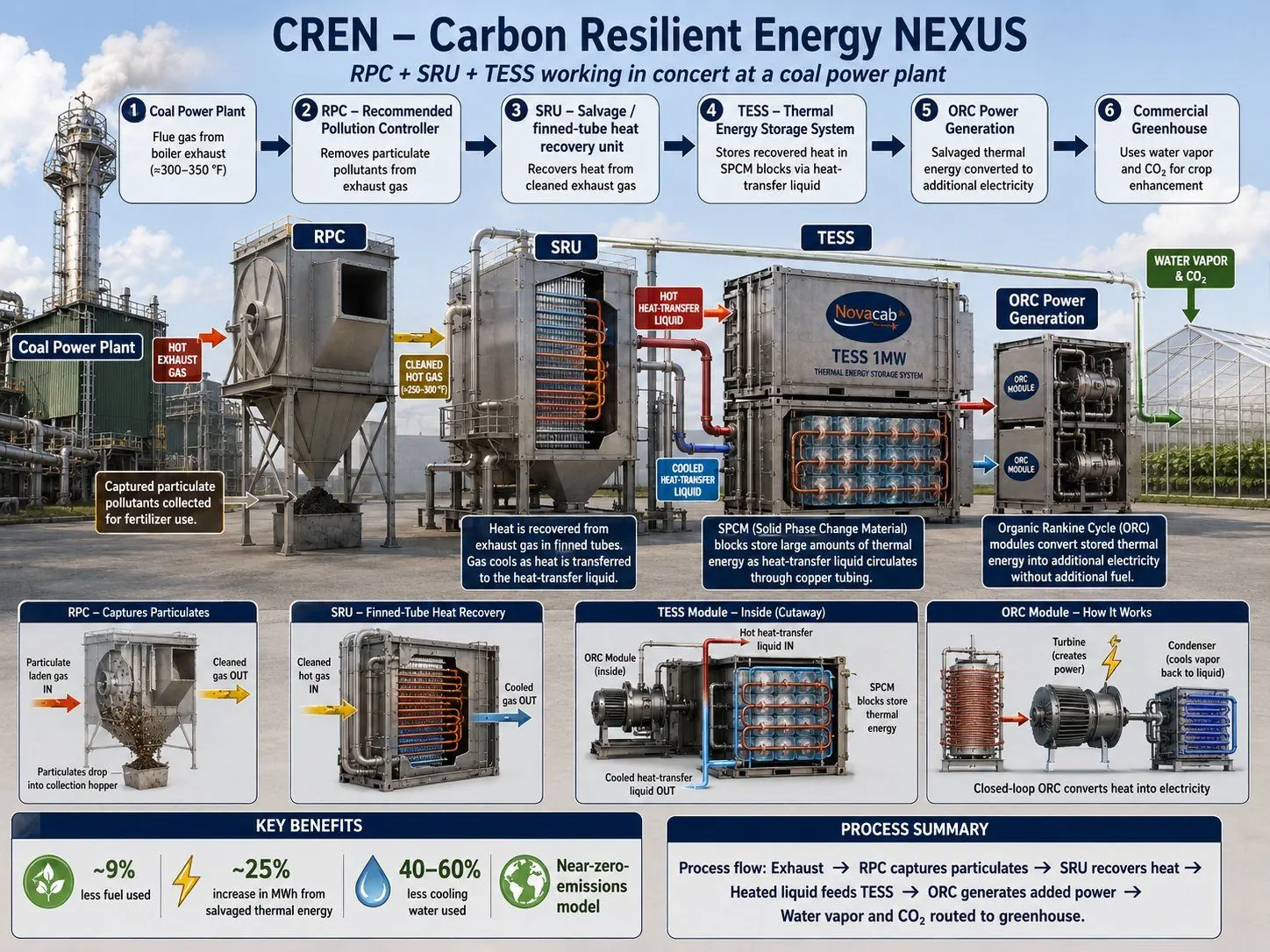
The boiler flue gas still carries heat after the economizer and air heater. A condensing flue gas unit such as the Sidel SRU is built to take that heat. On a bagasse boiler the gas is wet and dusty, so the design has to handle both. We explain the physics in how much heat a boiler loses up the stack.
4. Control the dust
Bagasse ash fouls heat exchange surfaces and has to come out of the flue gas before it can be cooled safely. The Sidel RPC is a self-cleaning rotary particulate collector with one moving part. It is designed to sit ahead of heat recovery on exactly this kind of gas. See also how to choose a particulate collector.
5. Smooth the pan and condenser load
Pans pull heat in bursts. A phase-change thermal store such as Novacab TESS can absorb and release heat to flatten those swings, which helps hold vacuum steady. Higher-temperature streams can also be assessed for ORC waste-heat-to-power. Our sugar mill page sets out the pilot approach: start with one representative pan.
What savings are worth: an illustrative example
This is example arithmetic only. The numbers are invented to show the method. They are not a quote and not from any real mill.
| Input | Example value |
|---|---|
| Cane crushed in a season | 1,000,000 tonnes |
| Steam on cane, before | 50 percent (500,000 t steam) |
| Steam on cane, after | 45 percent (450,000 t steam) |
| Steam saved | 50,000 tonnes per season |
| Value of surplus power from freed bagasse | depends on your tariff and boiler |
Five points of SOC on a mill this size is a large volume of steam. Whether it becomes exported power, saved fuel or a second product depends on your boiler, turbine and tariff. That is why the next step is metering, not a brochure.
Savings from any recovery or storage equipment are engineered targets until a metered baseline and a pilot confirm them. They are not guarantees. Sidel CREN starts with a data request: pan vapour flow, vacuum, condenser and spray-pond data, boiler data and your crushing schedule. See how we work.
Quick answers
How much steam does a sugar mill use?
Mills often express steam use as a percentage of cane crushed, called steam on cane. One published study describes a mill as efficient when steam on cane is below 50 percent, and as able to cogenerate power for sale when it is below 40 percent. Real mills vary widely, so the only number that matters is your own metered figure.
Why does saving steam matter if a mill burns its own bagasse?
Bagasse is a by-product of crushing, but it is not free. Every tonne burned for process steam is a tonne that cannot be burned to make exported electricity, or kept for other uses. Lower steam demand turns the same bagasse into more surplus power.
What is the quickest way to find sugar mill energy savings?
Meter steam by area, then look at the evaporators, pans and heaters first. In one published study, rearranging how vapour from the evaporators feeds the heaters and pans cut a mill's steam on cane from 51.6 percent to 43.6 percent. Pan and condenser areas are also where stabilising heat and vacuum can help.
- Daniyanto & Rifai, “Application of Pinch Analysis to Reduce Steam Consumption in the Process House of a Sugar Factory,” Jurnal Rekayasa Proses, Vol. 7, No. 1, 2013 (Universitas Gadjah Mada)
- Wheatley et al., “Dryer design parameters and parts specifications for an industrial scale bagasse drying system,” Acta Agronomica, 69(4), 2020 (James Cook University)