Aerial view of the first industrial Sidel RPC installation
SRU × RPC × NOVACAB TESS

Half the world's energy
goes up the stack.

Roughly half the energy industry pays for is rejected through chimneys, condensers and cooling towers. Sidel CREN recovers energy you have already bought — and gives it back as clean power, water and food.

The alliance

Three proven technologies.
One accountable platform.

There are competitors for every individual component. The distinction here is the integration — a mature flue-gas condenser, an authorised particulate-capture technology, and thermal energy salvage, storage and conversion, delivered as a single U.S.–India project architecture with protected IP.

Sidel Systems USA

SRU Flue-Gas Condenser

A condensing economizer and heat-recovery platform for suitable boilers and generators. Recovers sensible and latent heat, condenses water vapour where chemistry permits, and cuts stack losses.

Practised since 1978 · 100+ industrial clients
SAI-DEL / Sidel Systems India

RPC Particulate Collector

The Rotating Particulate Collector for coal, wood, biomass, municipal waste, fuel oil and other particulate-heavy exhaust streams — the missing pillar for solid-fuel operations.

Invented by Parthosarathy Mukherji · U.S. Patent 9,682,340
Smart Phases / Novacab

Novacab TESS

Thermal energy salvage, storage and conversion using synthetic phase change materials. Stores recovered heat, stabilises processes, and converts qualifying heat above ~53–55 °C into behind-the-meter electricity.

Invented by Dr. Stephane Bilodeau, Eng., Ph.D., FEC
The bigger picture

This isn't an efficiency gadget.
It's a rethink of the entire stack.

There's a lot of energy-saving tech out there. What makes this different is the scale of what full deployment can achieve — at the power plant, at the cooling tower, in the data centre, and in the atmosphere.

−0%
global energy consumption — the 1/3 reduction target of full deployment
−0%
power-plant fuel input, by recovering heat the plant already paid for
+0%
net power output from the same plant, the same fuel
−0%
water consumption at strong-fit sites — heat is harvested before it becomes cooling burden
−0%
cooling-tower energy use
−0%
data-centre cooling energy consumption
0%
design collection efficiency of the Rotary Particulate Collector, down to 0.1 micron
overall heat entering the atmosphere — waste heat is put to work instead of dumped
How to read these numbers

These are engineered targets, drawn from reference plants and analysis — not a quote for your site. Fuel, output, water and emissions figures become real numbers only after a metered baseline, a site thermal map, a bypassable pilot and third-party measurement. That sequence is our approach, and we don't skip it.

The system — click any step to go deeper

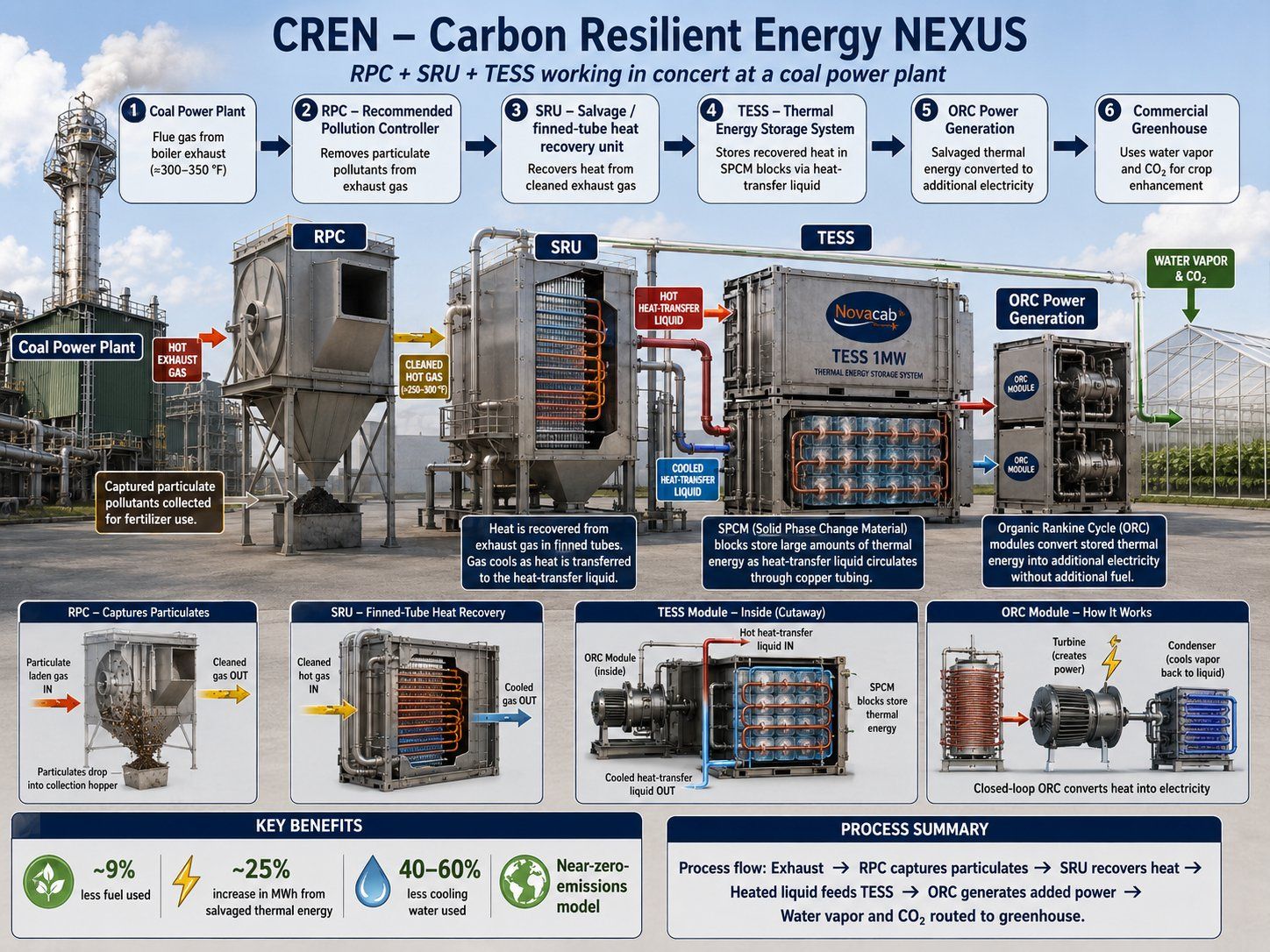
From hot flue gas
to clean wattage, water & food.

One integrated retrofit built from proven technologies. The story is simple — every step below has its own page if you want the engineering.

Start

🔥 Boiler

Hot flue gas leaves the combustion process — full of particulates and paid-for heat.

 
Step 1 · Sidel

Rotary Particulate Collector

Removes ~90% of particulates and recovers heat. Patented, self-cleaning, one moving part.

Explore RPC →
Step 2 · Sidel

SRU Flue Gas Condenser

Recovers the remaining low-grade heat — and clean condensed water. Proven since 1978.

Explore SRU →
Step 3 · CREN

PCM Heat Storage

Novacab TESS thermal batteries bank the recovered heat in phase-change material.

Explore Storage →
Step 4 · TESS

ORC + Turbine

Stored heat is converted to clean, dispatchable electricity — on demand.

Explore Power →
Step 5 · Value

Greenhouse & Clean Stack

Cleaned CO₂ and water vapor grow food year-round. What's left exits the stack clean.

Explore Greenhouse →
Where PCM fits into a power plant — Boiler to Sidel RPC to Sidel SRU to CREN PCM heat storage to TESS ORC turbine to clean stack
Where it all fits in a power plant: waste heat is recovered by the Sidel RPC and SRU, stored as latent heat in CREN PCM storage, then converted to additional power by the TESS ORC turbine — all before the gas exits the stack.
Where it applies

Four industries.
The same thermal problem.

Every one of them buys fuel, uses a fraction of the heat, and rejects the rest. Each has its own waste map, its own pilot, and its own data request.

Industry 01

🥛 Large Dairy

A 365-day heat-and-cooling machine — you pay to heat the product, then pay again to cool it. Milk reception, pasteurisation, CIP, drying, cold storage, boilers and effluent.

Dairy waste map →
Industry 02

🌾 Sugar Mill

A thermal plant with a product attached. Batch-pan crystallisation and condenser/spray-pond systems hold the largest recoverable and stabilisable load in the mill.

Sugar reference case →
Industry 03

⚡ Fossil Power — Gas & Coal

Stack heat, condenser heat, cooling towers, blowdown and auxiliary losses. Coal adds particulate — which is exactly what the RPC was built for.

Gas & coal cases →
Industry 04

🏗️ Steel & Metals

The deepest heat map of all: furnaces, coke and sinter, reheating, EAF, rolling, quench loops, off-gas and dust systems — high-grade and low-grade streams at once.

Steel heat streams →
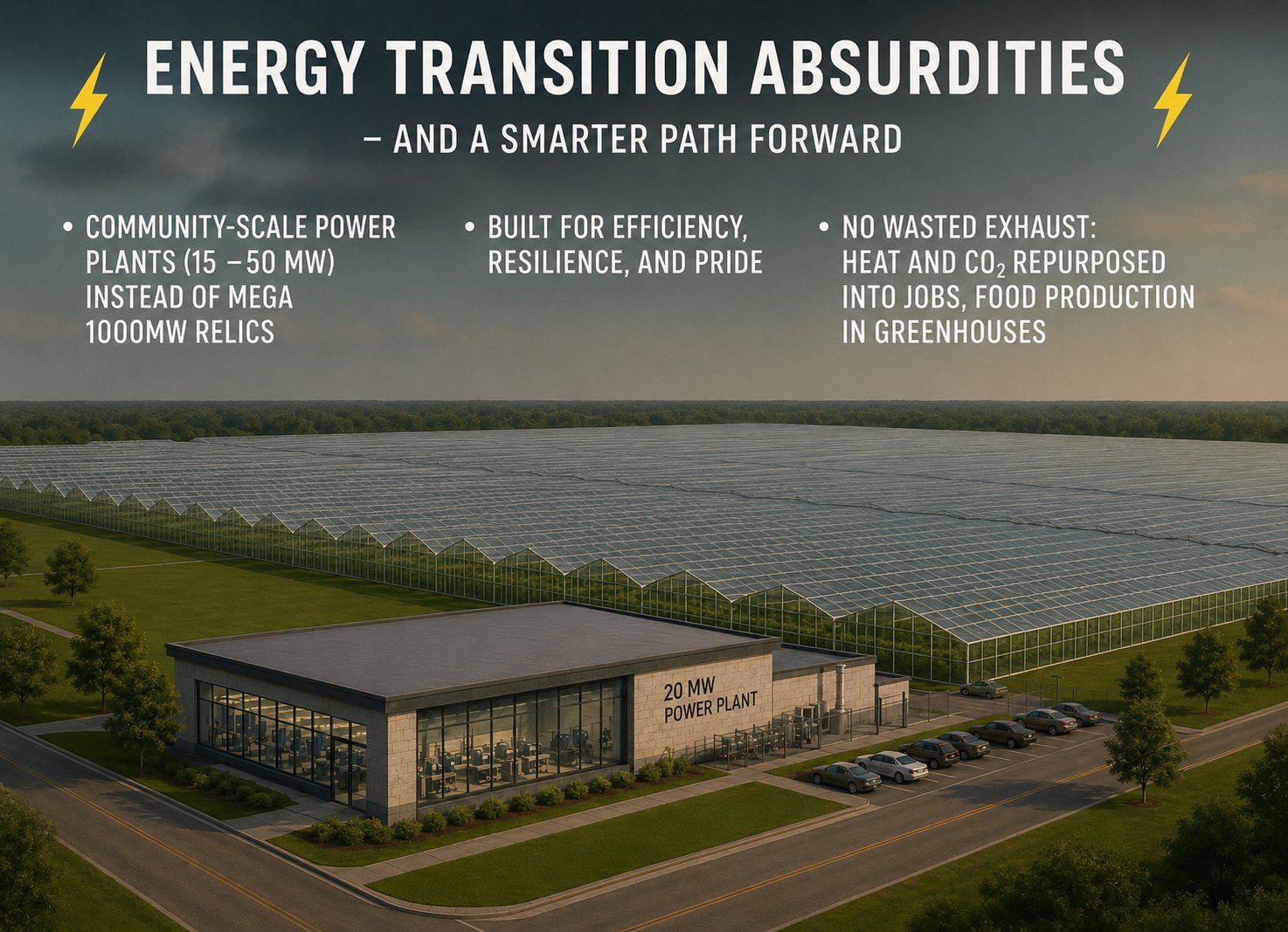
Community-scale power plant with greenhouse campus
The vision

No wasted exhaust.
Heat and CO₂ become jobs and food.

Community-scale power plants (15–50 MW) built for efficiency, resilience, and pride — with exhaust repurposed into year-round greenhouse food production instead of dumped into the sky.

Why believe it

We didn't invent a gadget.
We connected the proof.

🏭

Sidel SRU — since 1978

Sidel Systems' flue gas condenser has been recovering waste heat for industry for over four decades, across 100+ major clients.

🔋

~400 TESS batteries installed

Novacab thermal storage: 2007 ASHRAE International Excellence in Engineering Award at IBM Bromont, Gen 5 units now in the U.S.

📜

RPC — U.S. Patent 9,682,340

The Rotating Particulate Collector is patented (2017) and proven at India's first industrial installation.

The inventors are on the project.

This is an association, not a reseller. The people who invented the RPC, the SRU practice and Novacab TESS are the people who deliver the work — which is also why an authorised deployment is not the same thing as a copy of one.

Inventor · TESS

Dr. Stephane Bilodeau

Eng., Ph.D., FEC. Ph.D. in Energy and Advanced Thermodynamics, Fellow of Engineers Canada, former President of the Ordre des ingénieurs du Québec.

Inventor · RPC

Parthosarathy Mukherji

CTO, SAI-DEL / Sidel Systems India. Inventor of the Rotating Particulate Collector — the missing particulate-capture pillar for solid-fuel exhaust.

40+ years · SRU

Sid Abma

CEO, Sidel Systems USA. Four decades in flue-gas condenser, heat-exchanger and waste-heat recovery practice.

Meet the full alliance →
Technology proven at
IBM BromontE&J GalloDarigoldKruger Pulp & PaperMontreal Stock ExchangeMission LinenHarris Ranch
Sidel CREN logo
CREN — Carbon Resilient Energy Nexus
TESS thermal energy storage
★ The Iron-Clad Guarantee

"You will be 100% satisfied with the money saved, CO₂ emissions reduced, water conserved, and exceptional service — or we'll buy your unit back from you. Period."

Get started in 3 steps

Request a consultation.
See what your waste is worth.

Request a consultation → receive a data request and a bypassable pilot plan → measure the results. Virtual or on site, no obligation.

Or reach Michael Logan directly — michaellogan@sidelcren.com · (281) 813-2612